Because it's afraid of the car (or anything that's making a noise or seems threatening).
I have seen this many times, because we've had chickens. Chickens will cross the road for two reasons: They either want to cross because they have some urge to cross, such as to look for food on the other side. Or they hear a car coming, get startled, and start running towards their own flock, which might be on the other side. They feel safer with the other chickens and are willing to risk crossing the road to be with their own group. Safety in numbers overrides the risks of crossing the road. I think the question of why did the chicken cross the road came about because it happens so frequently that a chicken will cross the road right in front of your car and you wonder why it would do that (squirrels and deer do it too).


A brief history of modern life
Phase 1: Not doing everything yourself anymore:
Electricity, running hot water, the oven, the refrigerator, the supermarket, processed foods, the broker, the insurance company, the travel agent, the dating service, the government …
Phase 2: Not doing everything yourself anymore, while sitting down:
radio, television, the telephone, the automobile, the train, the airplane, the drive-through...
Phase 3: Doing everything yourself again, while sitting down:
Online-banking, -investing, -lobbying, -publishing, -travel planning, -reviewing, -defining, -mapping-shopping, -selling, -dating …
Electricity, running hot water, the oven, the refrigerator, the supermarket, processed foods, the broker, the insurance company, the travel agent, the dating service, the government …
Phase 2: Not doing everything yourself anymore, while sitting down:
radio, television, the telephone, the automobile, the train, the airplane, the drive-through...
Phase 3: Doing everything yourself again, while sitting down:
Online-banking, -investing, -lobbying, -publishing, -travel planning, -reviewing, -defining, -mapping-shopping, -selling, -dating …
The law of geographic perspective
In physical perspective objects further away look smaller and closer together and are harder to distinguish. There is an equivalent in cultural geography that seems to follow the same principles. The law of geo-cultural perspective: cultures further away seem to be almost indistinguishable. Many can't quite tell the difference between the Germans and the Dutch, the Hutu and Tutsi, Peru and Ecuador, China and Korea, Vietnam and Cambodia, Australia and New Zealand, Sweden and Norway. Sicily is mistaken as Italian, Bavaria is mistaken as German. In the US, all northern European folklore is mixed up as Polka (see Lawrence Welk). To the rest of the world, the US seems as one country, one culture; internally it seems like a world so diverse and complex as to eclipse the importance of the rest of the world.
Internal complexity distracts people from curiosity about the rest of the world. External complexity is considered irritating. Lack of curiosity about and irritation concerning other countries is externally labeled as ignorance.
Internal complexity distracts people from curiosity about the rest of the world. External complexity is considered irritating. Lack of curiosity about and irritation concerning other countries is externally labeled as ignorance.
New York's secret: medium tall
Manhattan is the only urban space that has tall buildings and a very active street life, in the same areas.
This is what makes it a "great city" — not its overall size, age, or wealth, or its monuments or its power or geographic position.
Just about every other city in the world with an active street life has low-rise buildings (take any old-world or latin American city.) There are, by now, many cities with high-rise buildings and street culture, but their exciting pedestrian action is located elsewhere in town (San Francisco, Chicago, New Orleans, Mexico City, Buenos Aires, Singapore, Shanghai, Frankfurt, Paris, etc.).
In New York City alone, a vibrant street life is truly framed by tall buildings, some very tall, but most just "tall," short by local standards and very high by international standards (15 to 40 stories) as well as completely normal size buildings (1 to 6 stories). And there are lots of these large buildings — it's not just a small area. All of midtown, parts of uptown and even the Village, and certainly the Wall Street district have so many tall buildings that most of them are anonymous, no one notices them or their desperate attempts at signifying wealth and status by alluding to ancient Greece or Rome, and Venice, Paris and London. Any one of them alone could be the star structure of any smaller city in the US.
I would like to emphasize the importance of "medium tall," as opposed to "sky scraper." Sky scrapers do little for cities except as icons, and only if they work visually from afar. They have very little of what I call "bottom life, " that is the street life that takes places in front of and because of them. "Medium tall" buildings, generate street life as effectively as any 19th century traditional building and are the secret to this exciting city, because there are many hundreds of them.
In Manhattan you are not just ON a street. You are IN a street, very much like in a medieval town. In New York, this social, vertical experience still exists, proportionally translated into our time. The tallness of structures doesn't seem to impede culture in New York. In every other city, as far as I know, the vibrancy of public space rapidly decreases in exact proportion to the height and modernity of its buildings. In New York, height actually creates social enthusiasm. In all other cities, height is felt as an expression of distance and arrogance.
But, in New York, too, the real cultural centers are in the shorter (older, nineteenth century) areas; so the pattern applies here as well, but less. New York's cultural ferment is so productive that it seems to elevate the high-rise zones, Wall Street and Midtown, to the point of being "alive" even at night.
I speculate that this may have to do with the fact that New York City has developed tall buildings — buildings that would require an elevator — much earlier than other cities. Height showed up in Manhattan before modernism (in the Bauhaus or internationalist sense). New York didn't just invent skyscrapers, it normalized "tallness" in the mixed-use urban environment. New Yorkers made tall buildings while people still knew how to create architecture that doesn't interrupt urban flow. New York had tall buildings with the sound of horses in the streets.
The obvious pattern is that the more a city contains nineteenth century (or earlier) construction, the more street life it has. New York is nineteenth century enough to be culturally functional while prospering in the twentieth century enough to maintain verticality.
This is what makes it a "great city" — not its overall size, age, or wealth, or its monuments or its power or geographic position.
Just about every other city in the world with an active street life has low-rise buildings (take any old-world or latin American city.) There are, by now, many cities with high-rise buildings and street culture, but their exciting pedestrian action is located elsewhere in town (San Francisco, Chicago, New Orleans, Mexico City, Buenos Aires, Singapore, Shanghai, Frankfurt, Paris, etc.).
In New York City alone, a vibrant street life is truly framed by tall buildings, some very tall, but most just "tall," short by local standards and very high by international standards (15 to 40 stories) as well as completely normal size buildings (1 to 6 stories). And there are lots of these large buildings — it's not just a small area. All of midtown, parts of uptown and even the Village, and certainly the Wall Street district have so many tall buildings that most of them are anonymous, no one notices them or their desperate attempts at signifying wealth and status by alluding to ancient Greece or Rome, and Venice, Paris and London. Any one of them alone could be the star structure of any smaller city in the US.
I would like to emphasize the importance of "medium tall," as opposed to "sky scraper." Sky scrapers do little for cities except as icons, and only if they work visually from afar. They have very little of what I call "bottom life, " that is the street life that takes places in front of and because of them. "Medium tall" buildings, generate street life as effectively as any 19th century traditional building and are the secret to this exciting city, because there are many hundreds of them.
In Manhattan you are not just ON a street. You are IN a street, very much like in a medieval town. In New York, this social, vertical experience still exists, proportionally translated into our time. The tallness of structures doesn't seem to impede culture in New York. In every other city, as far as I know, the vibrancy of public space rapidly decreases in exact proportion to the height and modernity of its buildings. In New York, height actually creates social enthusiasm. In all other cities, height is felt as an expression of distance and arrogance.
But, in New York, too, the real cultural centers are in the shorter (older, nineteenth century) areas; so the pattern applies here as well, but less. New York's cultural ferment is so productive that it seems to elevate the high-rise zones, Wall Street and Midtown, to the point of being "alive" even at night.
I speculate that this may have to do with the fact that New York City has developed tall buildings — buildings that would require an elevator — much earlier than other cities. Height showed up in Manhattan before modernism (in the Bauhaus or internationalist sense). New York didn't just invent skyscrapers, it normalized "tallness" in the mixed-use urban environment. New Yorkers made tall buildings while people still knew how to create architecture that doesn't interrupt urban flow. New York had tall buildings with the sound of horses in the streets.
The obvious pattern is that the more a city contains nineteenth century (or earlier) construction, the more street life it has. New York is nineteenth century enough to be culturally functional while prospering in the twentieth century enough to maintain verticality.
Vernacular architecture, southern zone and northern zone compared
You see it most clearly in Italy, but also in any areas south of the Alps in Europe and eastward, along the Mediterranean to the Middle East and onwards to South Asia. You also see it south of the US border in the Americas: a continuous positive development in urban, vernacular architecture. Let's call this architectural area, the "southern zone" for the sake of brevity. I'd like to compare it to the "northern zone" using central Germany for that, and central Italy for the southern zone, as examples.
In the northern half of this divide, vernacular architecture has suffered a severe break as a result of the general influences of modernism and specifically the ideas of Bauhaus and its relatives, imitators, and inadvertent followers. There, building has become angular, industrial, grey and cold. The general reputation of "modern architecture" is that of emotional and functional sterility, mainly because of its northern zone incarnations. There, because of war or "urban renewal" or rampant development destroyed enough of the old to build the new in massive quantities. This sterility is most acute with official, industrial, and corporate building but also in residential urban, even suburban building.
In Northern (Anglo) America this sterility in the vernacular style is coupled with a kind of chintziness, a cheapness of construction, intended for short term existence or quick turnaround within the real estate market. In Anglo America, the industrial aspect of modernism has been completely and uncritically absorbed, without the original revolutionary and aesthetic ideas, in part because it fit an already persistent no-frills, short-term, earth-is-merely-a-steppingstone mentality. In the US, place (and earthly life) is something you merely move through. Vernacular architecture is on the level of military barrack, a temporary station. Churches, farms, stores, homes are built as temporary warehouses, sometimes patched up a little with mass produced classicist decorations to add "class" or cozyness.
In Northern (Anglo) America this sterility in the vernacular style is coupled with a kind of chintziness, a cheapness of construction, intended for short term existence or quick turnaround within the real estate market. In Anglo America, the industrial aspect of modernism has been completely and uncritically absorbed, without the original revolutionary and aesthetic ideas, in part because it fit an already persistent no-frills, short-term, earth-is-merely-a-steppingstone mentality. In the US, place (and earthly life) is something you merely move through. Vernacular architecture is on the level of military barrack, a temporary station. Churches, farms, stores, homes are built as temporary warehouses, sometimes patched up a little with mass produced classicist decorations to add "class" or cozyness.
In the southern zone, too, there is some non-vernacular building which is horribly cold and detached, mostly because it involved architects who probably had their eye on high modernism, or because some state agency without public input. But the general landscape is not shaped by a few official buildings, but by the general trends in vernacular construction, which could range from completely self-built, to moderately professional building involving architects.
To put it very bluntly, the southern zone is much more beautiful, because humanity creates beauty there. In the north (with plenty of exceptions of course) the vernacular tends towards hideousness, enthusiastically. If you don't agree, go and compare central Mexico with the US Mid-west, or Havana with Jacksonville, or Naples with Duisburg. Latin America and latin Europe are much more beautiful than Anglo America and Northern Europe; that's a subjective assessment, of course, but I'm willing to defend it. If cleanliness and order are an important part of your aesthetic, then this relation would be reversed. I recently talked to someone in my home town, who advocated more organized intervention and rebuilding in some of the most delapidated but romantic aspects of the town. I mentioned my appreciation for Naples, where a certain casualness and collaborative aesthetic makes for overwhelming beauty, and my disdain for Germany's overly anxious modernization. He countered that Naples is a terrible example, because there the beaches are dirty and shameful. He sees things in terms of order and cleanliness, places in terms of economic activities (tourists bathing, for example), which to him signify responsibility and pride. He must have completely missed the Naples I enjoyed.
To put it very bluntly, the southern zone is much more beautiful, because humanity creates beauty there. In the north (with plenty of exceptions of course) the vernacular tends towards hideousness, enthusiastically. If you don't agree, go and compare central Mexico with the US Mid-west, or Havana with Jacksonville, or Naples with Duisburg. Latin America and latin Europe are much more beautiful than Anglo America and Northern Europe; that's a subjective assessment, of course, but I'm willing to defend it. If cleanliness and order are an important part of your aesthetic, then this relation would be reversed. I recently talked to someone in my home town, who advocated more organized intervention and rebuilding in some of the most delapidated but romantic aspects of the town. I mentioned my appreciation for Naples, where a certain casualness and collaborative aesthetic makes for overwhelming beauty, and my disdain for Germany's overly anxious modernization. He countered that Naples is a terrible example, because there the beaches are dirty and shameful. He sees things in terms of order and cleanliness, places in terms of economic activities (tourists bathing, for example), which to him signify responsibility and pride. He must have completely missed the Naples I enjoyed.
The built landscapes of the southern zone are mostly beautiful, joyous, rich in detail, full of life. Usually there is also grit (various layers of dirt due to less than perfect maintenance). In places like southern Italy you may add hanging laundry to the picture (a.k.a "life"). There is harmony between the individual building and the mass of buildings. Most importantly, there is harmony within the full range of historical periods. A 20th century building next to a 16th century building, despite stylistic differences, may look perfectly harmonious, as if the basics of human needs and collective taste have remained consistent.
In trying to understand this break – between the pre-modern and modern in the North and the lack of it in the South – I've looked at several possible culprits.
Protestantism's visual severity
The notion that protestants are against fun is an old cliché, so I won't dwell too much on it. The basic theory is that when protestants (Germans, Swiss, French, English, Dutch) protested the hegemony and decadence of the Catholic church they did away with imagery (iconoclasm) and decoration in their churches and buildings. The church responded with the counter reformation, making their churches even more fun and lascivious (the Baroque). Church buildings and the religions of rulers of course influence the culture of building greatly, so it makes sense that in protestant areas, the built environment is less joyous, indicating seriousness and solemnity. There have been many references to modernism being an extension of protestantism. So, it could be that the northern tendency to make the built environment look dreary is a subconscious imperative to be solemn, serious, but also in line with modernist fashion. The words to be feared in the north are "decorative" and "frivolous" (unseriös - in German - literally un-serious) and superficial (being only on the surface, instead of being visibly structural – an essential modernist notion).
The north's greater degree of industrialization.
Northern England, Belgium, Northern France, Central Germany — these are the (European) areas of the industrial revolution. The built environment there is accustomed to being dominated by progress, instead of romanticism. In Northern Italy, the Po region is heavily industrialized as well, and is less pretty than the areas further south. It could be that the collective aesthetic is formed by whatever dominates politically and economically, in this case industry. As a result, vernacular structures end up as dreary as industrial ones. Maybe, the art of making things beautiful simply gets lost in the face of overwhelming context. An additional element is that industrial areas are often newer, historically, and so less layered in terms of human habitation, showing a shorter spectrum of architectural creativity, which in turn affects the creativity of the vernacular. Or is it that the same tendency to industrialize, to prioritize work and functionality, also lowers the emphasis on fun and frivolity?
World War II and the "break with the past".
The notion here is that any kind of pedestrian, non-academic architectural beauty is associated with the past and thus rejected. Even though the Hitler era lasted only 12 years, it is associated with all previous fraudulent nativism and local folklore, with the bourgeoisie, with conformism and primitive hierarchy and only gradual advances. Modernism advocated a rupture, a revolution, and resulted in "throwing out the baby with the bathwater", that is the traditions of the vernacular, popular, bottom-to-top approach. Architecture, as currently taught, and even the vernacular kind, is managed from the top of the hierarchy, from the architect or "builder," the craftsman merely executing the concept (see Mies van der Rohe). Any evidence of visual warmth or errant crafted detail became taboo in the North. Craftsmen have to pretend to be industrial, to be the tip of the pen. This didn't seem to have happened as much in areas less destroyed by and feeling less guilty about world war II (Italy has a less radical rejection of Mussolini, Spain an even less radical rejection of Franco). In the south, the entire building seems to be formed by its surrounding culture, not some trendy builder looking for attention through rupture, and conforms to the whole while also expressing an individuality.
Climate and color harmony: the use of warm "impure" colors.
Color preferences in Germany and Italy, and in the "northern zone" and the "southern zone" are completely different. In the northern zone, things are either too grey or too vibrant. Greyish hues are very mixed: there are all kinds of dreary reds and browns. Whites are pure white, colors are very bright, such as green, which is usually a weird lime green, reflecting the color of grass in all seasons. In northern Europe there is a lot of rain, and winters are mild, so grass and tree trunks remain green all year. In the south, grass ranges from olive to beige. When Germans think of color, they think of bright, pure colors, like those of flowers and fruit and grass. In the south, colors are part of an immense spectrum, and rarely "pure". Grey is simply another color on this spectrum.
Or, to put it very simply: In the built environment of the south, colors are always part white and part black. A typical row of buildings will have hundreds of shades of red, yellow, blue, green, but always pastel with some patina. Colors are held back and mixed, and become completely compatible with each other. The southern color palette allows freedom of collage, because the colors are not pure (unlike a Mondrian painting, the epitome of modernism and protestantism). They stick to the rule: hues of equal value (intensity) and sufficient impurity (patina) can be mixed infinitely. Everyone involved seems to understand this principle in Italy, also in nearby countries, with decreasing consistency westward and eastward (countries of the Caribbean region have their own harmonic rules, using very bright colors). I am sympathetic to the argument that climate is very important here, that the color of the sea, the land, the air influence the collective aesthetic. Italy is sunny and hazy (colorful but muted), Germany is grey and bright (and evenly lit). The caribbean is colorful and clear (not hazy), etc. So, the climate creates a color context which is more or less subconsciously "matched" by human creations.
Modernism as a mask for fascism
A recent, excellent article in Der Spiegel discusses the intricacies of postwar construction in Germany, and makes the point that in West Germany Nazi architects were re-integrated into the work force and continued their rather cold aesthetic under the label of modernism and Bauhaus. This doesn't explain the ugliness in the rest of the northern zones, but makes an important link between fascism and modernism, which are usually presented as opposite directions. The standard notion of fascism as retrograde (traditional) and modernism as progressive is undermined by the point that modernism, mostly in architecture, has a fascist component. I prefer to think that architecture, as a client-financed or applied art which requires significant up-front monies is simply much more likely to aestheticize power, than other "freer" arts such as literature and the visual arts, which can afford to be more personal and counter-cultural.
Which if of these factors is more important, and are there more to consider? Below are some images taken in Naples, italy, and Duisburg, Germany. Both are busy working class cities, although Naples is not as industrial and Duisburg is much smaller. Duisburg, as part of the Ruhr District, is typical (maybe a caricature) of the dreariness that is common in Northern Europe, despite the fact that residents are so often immigrants from more southern parts of the world. Naples is typical of southern Italy's grit and beauty. The comparison isn't meant to be fair, rather I am trying to contrast representative examples of the difference between the North and South. Below are some snapshots I took on walks and from the car.
Modernism as a mask for fascism
A recent, excellent article in Der Spiegel discusses the intricacies of postwar construction in Germany, and makes the point that in West Germany Nazi architects were re-integrated into the work force and continued their rather cold aesthetic under the label of modernism and Bauhaus. This doesn't explain the ugliness in the rest of the northern zones, but makes an important link between fascism and modernism, which are usually presented as opposite directions. The standard notion of fascism as retrograde (traditional) and modernism as progressive is undermined by the point that modernism, mostly in architecture, has a fascist component. I prefer to think that architecture, as a client-financed or applied art which requires significant up-front monies is simply much more likely to aestheticize power, than other "freer" arts such as literature and the visual arts, which can afford to be more personal and counter-cultural.
"These architects were quick to pretend [deny] that they had absolutely anything to do with the bombastic architecture of the Nazis and their megalomaniacal ideology. After the war, Speer's architects hid behind Bauhaus, the modernist style initially developed by Walter Gropius and others before 1933. Because the Nazis had persecuted its followers, being associated with Bauhaus was good for one's career after the war -- and it allowed them to actively promote modernism free from historical ballast."
Which if of these factors is more important, and are there more to consider? Below are some images taken in Naples, italy, and Duisburg, Germany. Both are busy working class cities, although Naples is not as industrial and Duisburg is much smaller. Duisburg, as part of the Ruhr District, is typical (maybe a caricature) of the dreariness that is common in Northern Europe, despite the fact that residents are so often immigrants from more southern parts of the world. Naples is typical of southern Italy's grit and beauty. The comparison isn't meant to be fair, rather I am trying to contrast representative examples of the difference between the North and South. Below are some snapshots I took on walks and from the car.
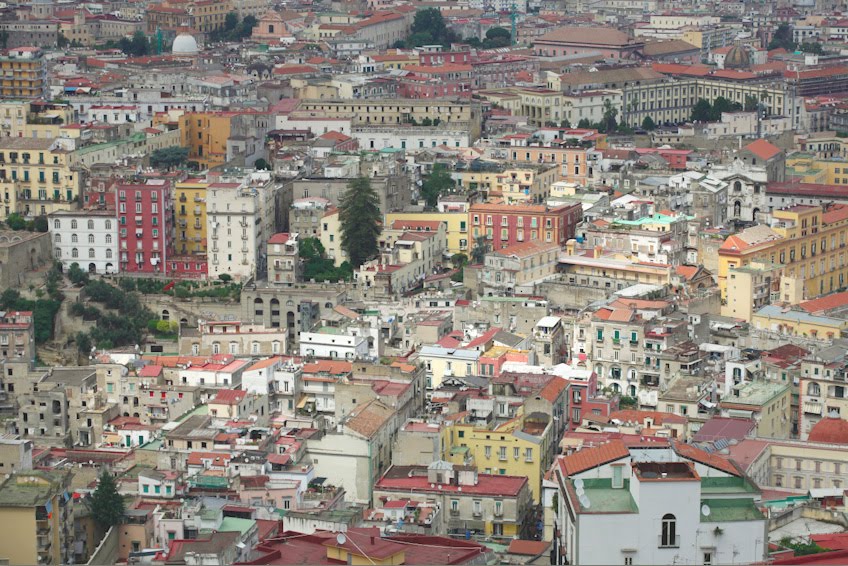 |
| Far view of Naples. All colors fit together. None are too intense. All contain some white and black (or brown). |
 |
| Naples street view: A modernist/internationalist building, (a building Darth Vader might love) on far right, dreary and hideous, but rare in Italy. Vernacular 20th century buildings in the center, full of life and warmth, and the usual 19th century building on the left, equally lively and warm. If you squint at both of the warm buildings you could notice that they average out to the same color, which is a muted yellow with both white and black infused.The newer building is just a little bolder in how the elemental colors are presented. |
 |
| A very similar situation, only reversed left to right. Internationalist, 20th century, 19th century. |
 |
| Another Naples street view. All are 20th century buildings, without the dreariness. Even the cars seem an integral part of the color composition. |
 |
| Duisburg, Germany. Are they TRYING to be depressing? Are they trying to conform to the weather? What causes this? |
 |
| More Duisburg. All colors are cold, all shapes are blocky. |
 |
| Duisburg again. These are pre-modern, so there's at least some curvature allowed. Here they are trying to not be depressing in their choices of color, but they go to far. It's what's called "Farbenfroh", meaning "color happy". The colors are way to intense and primary, and there's no patina (exceptions are the light yellow and the brownish ones in the back). The buildings don't fit together, in terms of color, they need muting. |
 |
| Duisburg; what I call provincial postmodern. Dreary, angular, psychopathic, non-functional. There is a lot of this in Germany (and in the Northern Zone) and it's baffling. |
Subscribe to:
Posts (Atom)